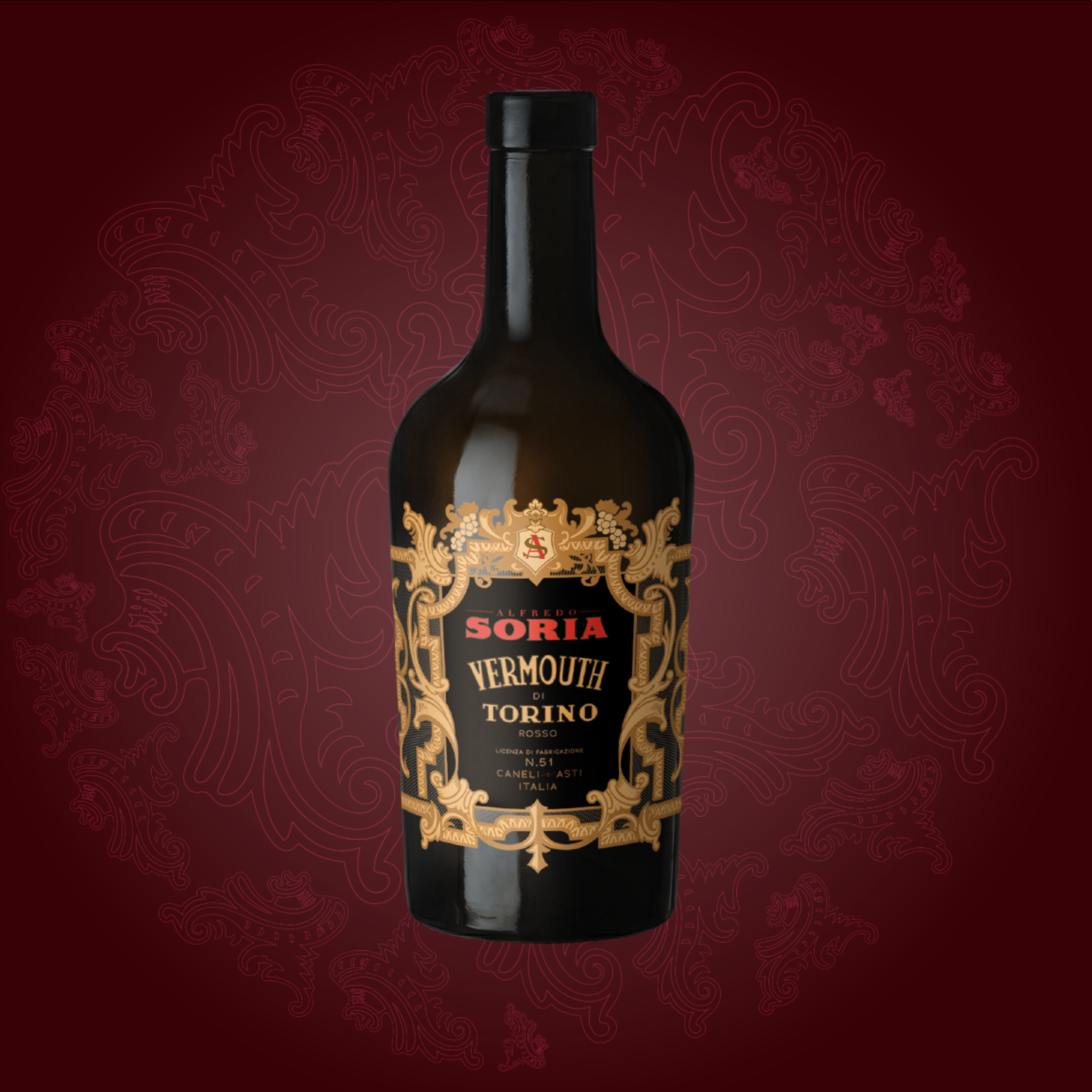
Our Vermouth
Alfredo Soria Original
The red Italian vermouth — Vermouth di Torino Rosso — naturally sweet and surprisingly light. Crafted in Piemonte on a double base of appellation wines, Piemonte Cortese DOC and Moscato d'Asti DOCG, following the family recipe Alfredo Soria first bottled in 1934. It is the heart of the Soria Vermouth Spritz, and it gives real character to the Negroni, the Manhattan and the Americano.
For those who love the ritual of aperitivo, but want something more refined — and more faithful to the place where vermouth was born.
Its aromatic character comes from a bouquet of botanicals true to the great Turin tradition: two Piedmontese wormwoods — gentile and romano, the heart and identity of an authentic vermouth — together with local herbs and spices. The recipe remains, as tradition demands, a family secret: it waited for decades in a bank safe-deposit box, until the relaunch.
Wine-led, not sugar-led.
Naturally expressive, never artificially forced.
Balanced enough to sip slowly, light enough to carry you through the evening.
"Since 75% of a bottle of vermouth is wine, it is essential to choose a base that enhances the botanicals and defines the overall character."
— Giulia Barbero, Founder & CEO
Serving Suggestions
- Neat, or over ice with a twist of orange
- In the classics: Negroni, Manhattan, Americano
- Alongside aged cheeses, olives and toasted nuts
The first release of the relaunch, the Heritage Edition, pays tribute to the rediscovered 1934 label.

The Two Wines
Why Cortese and Moscato
Here is a fact few drinkers know: the rules of Vermouth di Torino IGP require at least 75% of the bottle to be wine, made exclusively from Italian grapes. And yet much of the industry treats that three-quarters as mere support — neutral, anonymous bases chosen for cost rather than character. We made the more radical choice, and the one most faithful to tradition: two appellation wines, each with a name, a territory and rules of its own. When three-quarters of the bottle is wine, the wine should be worth naming.
Writers and enologists have long held that true Turin vermouth must be born of Moscato di Canelli — and when Piedmont's sparkling wine industry began absorbing ever more Moscato, vermouth makers turned to Cortese. Moscato and Cortese are the two historic grapes of Vermouth di Torino; bringing them together in one bottle reunites the category's two original souls.
The blend is roughly two parts Cortese to one part Moscato. Cortese brings freshness, a savoury edge and an understated finesse that lets the botanicals breathe; Moscato d'Asti DOCG adds its unmistakable aromatic lift and a natural grape sweetness that lets us hold back on added sugar. That balance is what "wine-led" truly means: naturally sweet without being heavy, aromatic without being artificial, with the depth of real wine beneath the spices.
Inside the Bottle
Seventy-five percent wine.
Nothing anonymous.
Artemisia gentile & romano
The two Piedmontese wormwoods — the heart and identity of an authentic Turin vermouth.
Moscato d'Asti DOCG
Aromatic lift and a natural grape sweetness, so we can hold back on added sugar.
Piemonte Cortese DOC
Freshness, a savoury edge, and the understated finesse that lets the botanicals breathe.
Herbs & spices
Local roots, barks and citrus peels, held to a recipe that remains a family secret.
Artemisia gentile & romano
The two Piedmontese wormwoods — the heart and identity of an authentic Turin vermouth.
Piemonte Cortese DOC
Freshness, a savoury edge, and the understated finesse that lets the botanicals breathe.
Moscato d'Asti DOCG
Aromatic lift and a natural grape sweetness, so we can hold back on added sugar.
Herbs & spices
Local roots, barks and citrus peels, held to a recipe that remains a family secret.
Technical Sheet
The bottle, in numbers
- Category
- Vermouth di Torino Rosso
- Origin
- Canelli, Piemonte — Italy
- Wine base
- Piemonte Cortese DOC & Moscato d'Asti DOCG
- Alcohol
- 16% vol.
- Bitter agent
- Artemisia gentile & Artemisia romana
- Recipe
- Family recipe, first bottled 1934
- Serve
- Chilled, 6–8 °C